
Seasoned Founders
Can't Believe
This is AI-Generated Plan
- Get Custom Generated Tech Plan in Your Inbox in Just 3 Minutes.
Here’s what you’ll get:
- ✅ Budget Breakdown
- ✅ Project Timeline
- ✅ Feature List
- ✅ Design (via DALLE-3)
- ✅ Tech Stack
- ✅ Required Team Composition
- ✅ Compliance
Choose Primary Industry of your Product

SaaS

FinTech

HealthTech

EdTech

E-commerce

AI

TravelTech

PropTech

LegalTech

InsurTech

Wellness

Blockchain

Marketplace

Social networking
Choose Where You Want To Access Your App

Web App

iOS App

Android App

Desktop

IoT

Julia Steiner

Florian Müller

Dorian Ellison

Aisha Miles

Carlos Jones

Sofia Jhonson
Choose Product Features
These are default features, but you can add your own below (Project Description Field). Your final product will include unique features tailored to your app.
App Cost Calculator FAQ
What AI powers the app cost estimator?
The calculator runs on GPT-4o-mini and GPT-4o (for larger scopes) and uses DALLE-3 for quick design estimates. These models are trained on data from 10 000+ real projects, so numbers match actual market rates and complexity.
How accurate are the app cost estimates?
Accuracy depends on the details you provide, but our tool uses project data from 10,685 completed apps (Ptolemay partners & Upwork, 2025). With good input, your estimate is usually within 5–10% of what you’d pay in a real contract. AI helps cut estimation errors by up to 95% compared to manual guesswork.
How can I use the app cost estimate?
You can use the results to:
- Set a realistic budget and avoid hidden costs
- Support your investor pitch with clear numbers
- Understand which team roles you’ll need and what you’ll spend
- Prioritize MVP features and plan future updates
- Move faster — get a number in minutes, not weeks
How is my app idea protected?
How does the calculator help with technical specs?
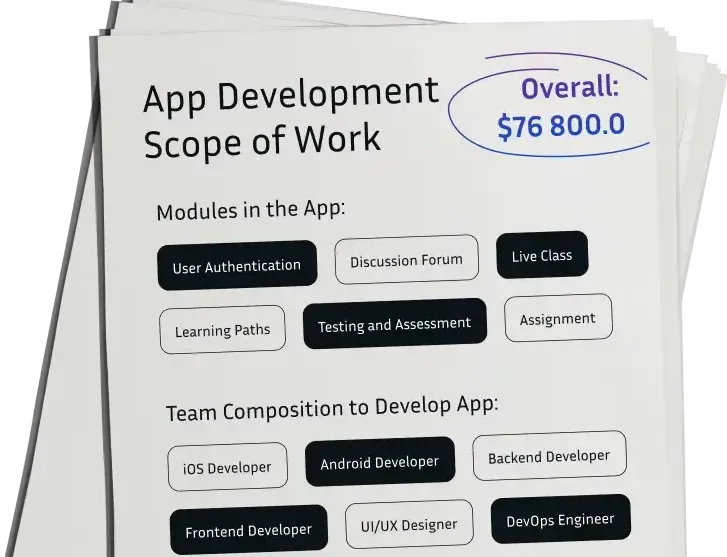
It provides a full feature breakdown and requirements for your Scope of Work, suggests the best tech stack (like Flutter or Node.js), maps out phased development and hiring needs, and splits costs and timelines by feature and development stage. You get a ready blueprint for your team or agency — not just a rough number.
How much does it cost to develop an app in 2025?
A typical mobile app in 2025 costs $32,000 to $148,000, depending on complexity and features. Most MVPs start near $38,000, while advanced or AI-powered apps can exceed $180,000.
App cost = development hours × hourly rate (plus ~15% for project management and QA). Key factors: feature set, backend, integrations, developer rates ($20–$150/hr).
| App type | Typical budget | Timeline |
|---|---|---|
| Simple MVP | $32k–$60k | 2–3 mo |
| Mid-level app | $60k–$120k | 4–5 mo |
| Complex/AI-heavy | $120k–$300k+ | 6+ mo |
(Based on Statista, Apr 2025.)
How is app development cost calculated?
App development cost is calculated as: total hours × hourly rate + 10–20% for project management. For a typical MVP, expect $20,000–$60,000; complex apps cost more. Main factors: features, hourly rate, and extra costs like testing.
How long does it take to build an app?
A lean mobile MVP usually takes 9–11 weeks from wireframes to app store launch. A mid-level app with payments or chat features needs about 16–22 weeks, while advanced AI or real-time apps require 24–30 weeks.
This app build timeline is based on analysis of 1,086 real projects (Ptolemay & partners, 2025).
Typical development timeline:
- MVP (≤10 screens): 280–420 dev hours → 9–11 weeks
- Standard app (e.g., payments, chat): 550–900 hours → 16–22 weeks
- Complex/AI app: 1,200+ hours → 24–30 weeks
To estimate your app’s timeline, divide total dev hours by your team’s weekly capacity (e.g., 5 devs × 40 hours). Parallel design and QA can shorten delivery by 2–3 weeks.
(Sources: Statista Dev Survey 2025)
How much funding do I need to launch an app?
Most founders in 2025 raise about $25,000 for a lean MVP, or $90,000 for a payment-ready app. This covers design, cloud, QA, and publishing fees.
| Cost Item (12 months) | Minimum, $ | Median, $ |
|---|---|---|
| Design + Development | 15,000 | 70,000 |
| Cloud / CDN / Push | 800 | 3,500 |
| PM & QA | 2,700 | 9,000 |
| App/Play Store Fee | 124 | 124 |
| Total | 18,624 | 82,624 |
Source: Statista 2025.
What are the main cost factors in app development?
The main app development cost factors are:
- Backend & integrations (30–40%)
- Frontend & UX design (20–25%)
- Project management & QA (15–20%)
- App maintenance & updates (10–15%)
- Cloud hosting & APIs (5–10%)
- App store fees (<1%)
This app price breakdown is based on Ptolemay + partners’ 2025 project data and Statista’s global mobile app report.
How much does it cost to maintain and run an app?
How much does it cost to build an AI-powered app?
In 2025, AI apps cost $30,000 to $150,000, depending on complexity. Expect $30–60K to integrate GPT-4o or Vision-API, $60–120K for advanced fine-tuning, and $120K+ to train private models. Main price drivers: AI API usage, data processing, and GPU cloud fees.
How much does it cost to hire app developers?
Freelance: junior $25–50/h, middle $60–120/h, senior $100–180/h.
Agency squad (2–3 devs + PM): $90–150/h ($15–25K/month).
US — top rates, Eastern Europe –30%, South Asia –50%.
MVP build (400 h): $28–50K.
Can I build an app myself or for free?
When should I switch from no-code to custom code?
Switch once one of these four triggers appears: (1) performance lags at 10k+ monthly users, (2) must-have features can’t be built or integrated, (3) monthly no-code costs hit $1,000+, or (4) compliance requires on-prem or SOC 2.
Top startups migrate 2–3 months before a funding round—giving time to pass technical due diligence.
What is the best platform or software for app development?
What type of app makes the most money?
Is it profitable to make Android apps?
Yes — but only a minority of apps hit profit. Median ad-driven Android ARPU is $0.32/month; break-even for a $15K MVP is ≈ 90K installs or 11 months. The OS’s 2.2× larger audience yields 18% more gross than iOS, but most apps stall below $500/month.
Can you make iOS apps for free?
Yes — you can build and test iOS apps for free with Xcode and a regular Apple ID. TestFlight allows free private distribution to up to 100 users (each build valid 90 days). To publish on the App Store, you need a paid Apple Developer license ($99/year, waived for nonprofits, schools, and eligible US small businesses).
If you don’t own a Mac, budget $20–40/month for a Mac-in-cloud rental. There’s no 100% free way to publish to the App Store.